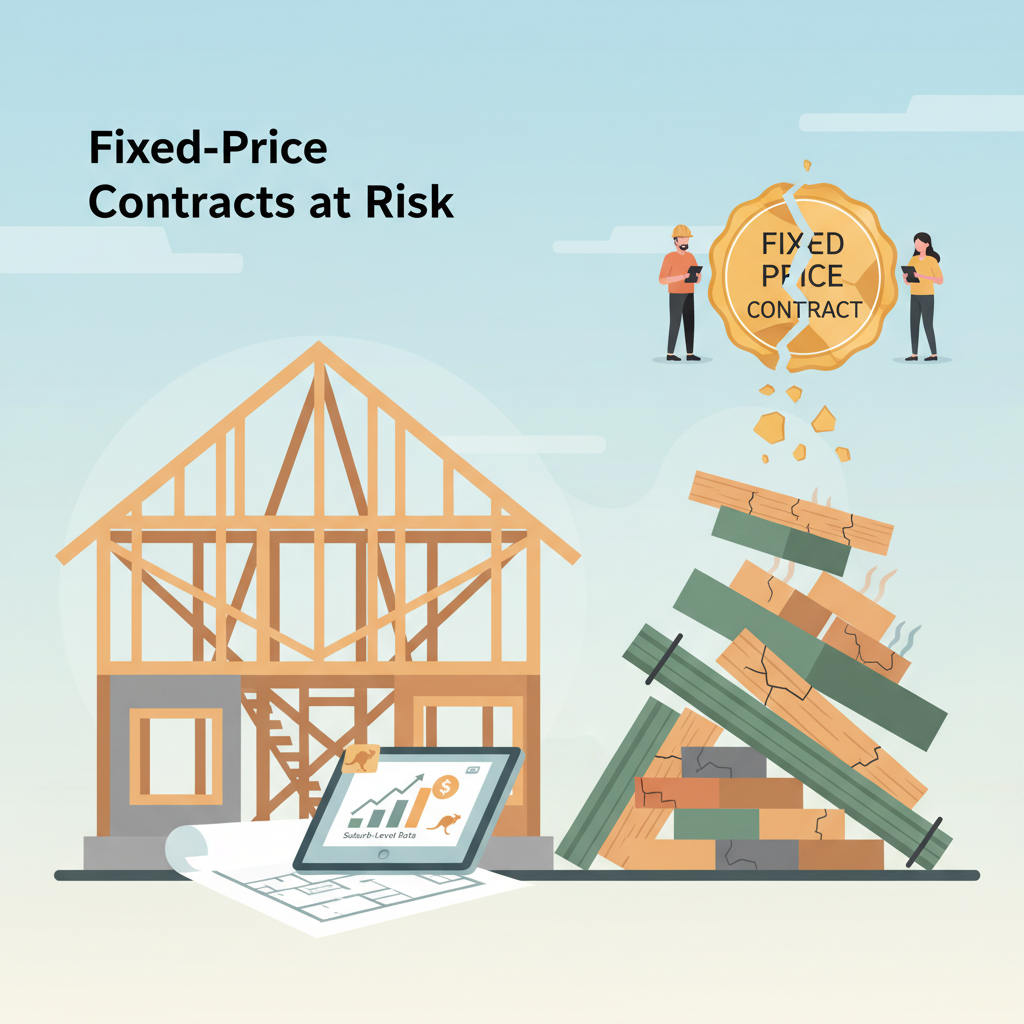
TL;DR: Surging material costs for essential items like PVC piping, cement, and quarry products are severely threatening fixed-price building contracts across Australia. This puts immense pressure on builders, making many projects financially unviable and jeopardising the government’s 1.2 million housing target. Homeowners must understand the shifting risks and adapt their budget planning.
Key Takeaways
- Fixed-price building contracts Australia face serious challenges due to volatile material costs, especially for PVC, cement, and quarry products.
- Australian builders are seeing profit margins shrink. Many projects are becoming marginal or unfeasible, as reported by the Housing Industry Association (HIA) in Q1 2026.
- Construction material costs have seen double-digit percentage increases over the past year for key commodities, driven by global events and supply chain disruptions.
- You should expect builders to factor in higher risk premiums or introduce more flexible clauses into fixed-price contracts to manage construction material cost escalation.
- Using platforms like HomeBuildBudget for suburb-level cost data and builder quote comparison helps you navigate these uncertain market conditions.
- A contingency budget of 10-15% is more important than ever, even with what seems like a fixed-price agreement.
What is a Fixed-Price Building Contract and Why Are They Under Threat?
A fixed-price building contract is a legally binding agreement where a builder commits to completing your construction or renovation project for a predetermined total cost. Homeowners value this contract type for the budget certainty it provides, shielding you from unexpected price increases in labour or materials. However, these contracts are currently under severe threat in Australia.
The main reason for this threat is the extreme volatility and sustained upward trend in the cost of crucial building materials. What was once a predictable margin for builders is now a moving target, making it incredibly difficult to accurately price a project several months or even a year in advance. This creates significant builder fixed price contract risks.
According to the Australian Bureau of Statistics (ABS) Producer Price Index for Construction (Q4 2025), building material prices continued to rise, with some categories showing significant increases year-on-year. Global events, such as geopolitical conflicts in the Middle East and ongoing supply chain disruptions, continue to worsen these pressures. This pushes up energy costs and, consequently, the price of manufactured goods.
Understanding these underlying cost components is crucial for your budget planning. HomeBuildBudget’s Cost Calculator helps you estimate construction costs by room type, material grade, and suburb-level labour rates across Australia. This insight helps you understand the likely material costs before approaching builders, empowering you to negotiate more effectively.
How Are Rising Material Costs Impacting Australian Builders?
Rising material costs are hitting Australian construction businesses hard. Builders who signed fixed-price contracts prior to these recent surges are now finding their profit margins completely eroded or, worse, facing significant losses on projects. The sheer scale of construction material cost escalation means that financially viable projects are becoming marginal, and marginal projects are becoming unfeasible.
For example, the HIA reported in its April 2026 Housing Scorecard that builder sentiment is wary, with many reporting difficulties securing consistent material supply at previously quoted prices. This environment directly challenges the government’s ambitious target of building 1.2 million new homes over five years, as builders are less willing to take on projects with such high inherent risk. The Master Builders Australia (MBA) has also raised concerns about business solvency within the sector, particularly for smaller and medium-sized enterprises.
When builders face these pressures, they often have two choices: absorb the losses (which few can sustain long-term) or seek to renegotiate contracts, leading to disputes and delays. For you, this means longer wait times, potential project abandonment by struggling builders, or an initial fixed-price quote that is significantly higher to account for future uncertainties.
When comparing builder quotes, it’s important to see how they’ve accounted for material costs. HomeBuildBudget’s Builder Quote Comparison tool helps you compare up to five builder quotes side-by-side with AI-powered line item analysis. This helps you identify if a builder has factored in a realistic material price or if their quote is unusually low, potentially indicating future problems.
What Specific Materials Are Driving Cost Escalations?
Several key building materials are currently pushing up costs across Australia, making things tough for builders operating on fixed-price contracts. These are often foundational elements, meaning their price volatility impacts almost every project.
PVC piping has seen significant price increases, with some suppliers reporting increases of 15-20% over the past 12 months (Q1 2025 to Q1 2026). This is driven by global petrochemical prices, supply chain constraints from manufacturing hubs, and strong demand. PVC is critical for plumbing, drainage, and electrical conduits.
Cement production is highly energy-intensive, and with global energy prices remaining elevated, cement costs have surged. CoreLogic’s Building Cost Index for Q4 2025 indicated national cement price rises of 8-12% year-on-year. This impacts everything from concrete slabs and foundations to rendering and mortar.
Quarry products, including aggregates, sand, and crushed rock, are also experiencing upward pressure. Fuel costs for transportation and increased demand from major infrastructure projects contribute to these rises. In some regional areas, quarry product costs have jumped by 10-15% (Q1 2025 to Q1 2026), as noted by regional construction associations.
Material Cost Changes: Q1 2025 vs. Q1 2026 (Indicative)
| Material Category | Q1 2025 Average Cost Index | Q1 2026 Average Cost Index | Percentage Increase (approx.) | Primary Driver |
|---|---|---|---|---|
| PVC Piping | 100 | 118 | 18% | Petrochemical costs, global demand |
| Cement | 100 | 110 | 10% | Energy costs, manufacturing |
| Steel Reinforcing | 100 | 106 | 6% | Raw material scarcity, energy |
| Timber & Boards | 100 | 104 | 4% | Log supply, processing capacity |
| Quarry Products | 100 | 112 | 12% | Fuel for transport, regional demand |
Note: Cost Index represents relative price movement from a baseline of 100 in Q1 2025. Data is indicative based on market reports and ABS trends.
Even minor fluctuations in these fundamental material costs can add tens of thousands of dollars to a project, significantly affecting fixed-price agreements. Your budget should reflect these potential changes. HomeBuildBudget’s Suburb Cost Data offers detailed cost-per-square-metre data for 2,500+ Australian suburbs, updated quarterly, helping you understand local market realities for materials and labour.
Can Homeowners Still Secure a Fixed-Price Contract in Australia?
Yes, you can still secure a fixed-price contract in Australia, but the terms and conditions are changing a lot. Builders are more cautious now, changing their contracts to reduce the high builder fixed price contract risks associated with material cost volatility. This means your fixed-price contract might look different than it would have a few years ago.
Builders are now more likely to:
- Offer Shorter Fixed-Price Periods: Instead of fixing prices for 12-18 months, builders may only guarantee costs for 6-9 months, requiring a re-evaluation or adjustment clause if the project extends.
- Include Escalation Clauses: These clauses allow the builder to pass on specific material cost increases beyond a certain threshold to the homeowner. It’s important to understand what triggers these clauses and how increases are calculated.
- Use More Provisional Sums (PS) and Prime Cost (PC) Items: Provisional sums are estimated amounts for work not fully defined at contract signing (e.g., excavation if rock is uncertain). Prime Cost items are allowances for fixtures and fittings where the exact selection hasn’t been made (e.g., tiles, taps). While these provide flexibility, they shift some cost risk to you.
- Charge a Higher Initial Premium: Builders might include a larger contingency or risk premium in their initial fixed price to absorb potential future cost spikes. This means your upfront quote might seem higher than expected.
When reviewing a contract, look closely at clauses related to material price fluctuations, delays, and how provisional sums are managed. Your best defence against unexpected costs is detailed planning and clear communication. HomeBuildBudget’s Budget Tracker helps you track actual spending against estimates with real-time alerts, which is extremely useful for managing provisional sums and ensuring you don’t exceed your overall budget.
What Strategies Can Homeowners Use to Mitigate Risk?
In the current volatile market, homeowners building or renovating in Australia need smart ways to protect their budgets, even with a fixed-price contract. The impact of rising material costs on builders inevitably filters down to you.
- Thorough Contract Review: Get a legal professional to review your building contract. Pay close attention to clauses regarding material price increases, provisional sums, extension of time, and dispute resolution. Ensure you understand what constitutes a “fixed price” and where your liabilities lie.
- Build in a Contingency Budget: Even with a fixed-price contract, always allocate a contingency fund of 10-15% of your total project cost. This buffer can absorb unforeseen site conditions, minor variations, or material cost impacts from any escalation clauses.
- Detailed Specifications: Provide your builder with the most detailed specifications possible for materials and finishes before signing the contract. This reduces the number of provisional sum items and cuts down on misunderstandings or costly variations later.
- Communicate Openly: Keep communication regular and transparent with your builder. Understand their supply chain challenges and potential impacts.
Related Articles
Australian Construction Outlook 2026: Record Pipeline Meets Rising Costs
Australia's $450B construction boom meets persistent labour shortages and rising costs from global energy shocks. What homeowners need to know in 2026.
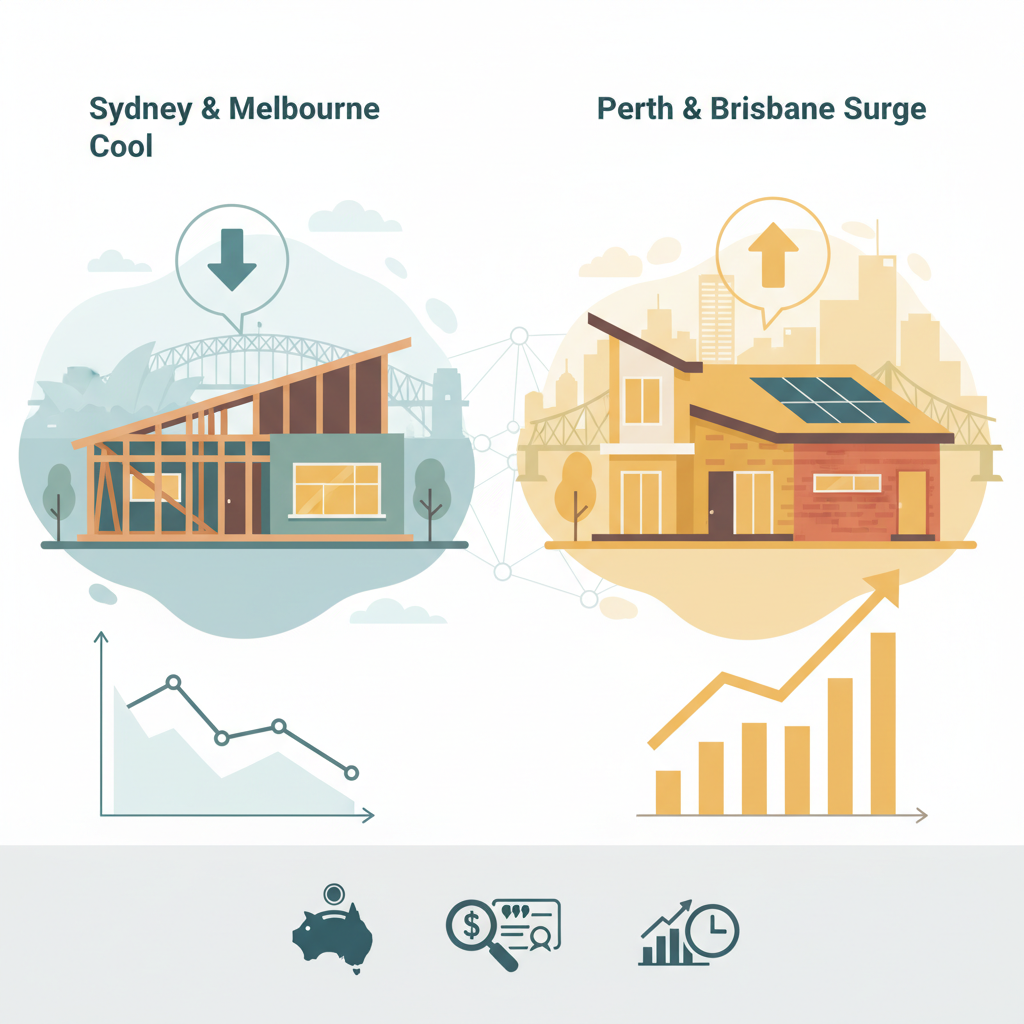
Australia's Two-Speed Housing Market: Sydney & Melbourne Cool, Perth & Brisbane Surge in 2026
Sydney and Melbourne prices decline while Perth and Brisbane surge in early 2026. How this two-speed housing market affects your building plans.