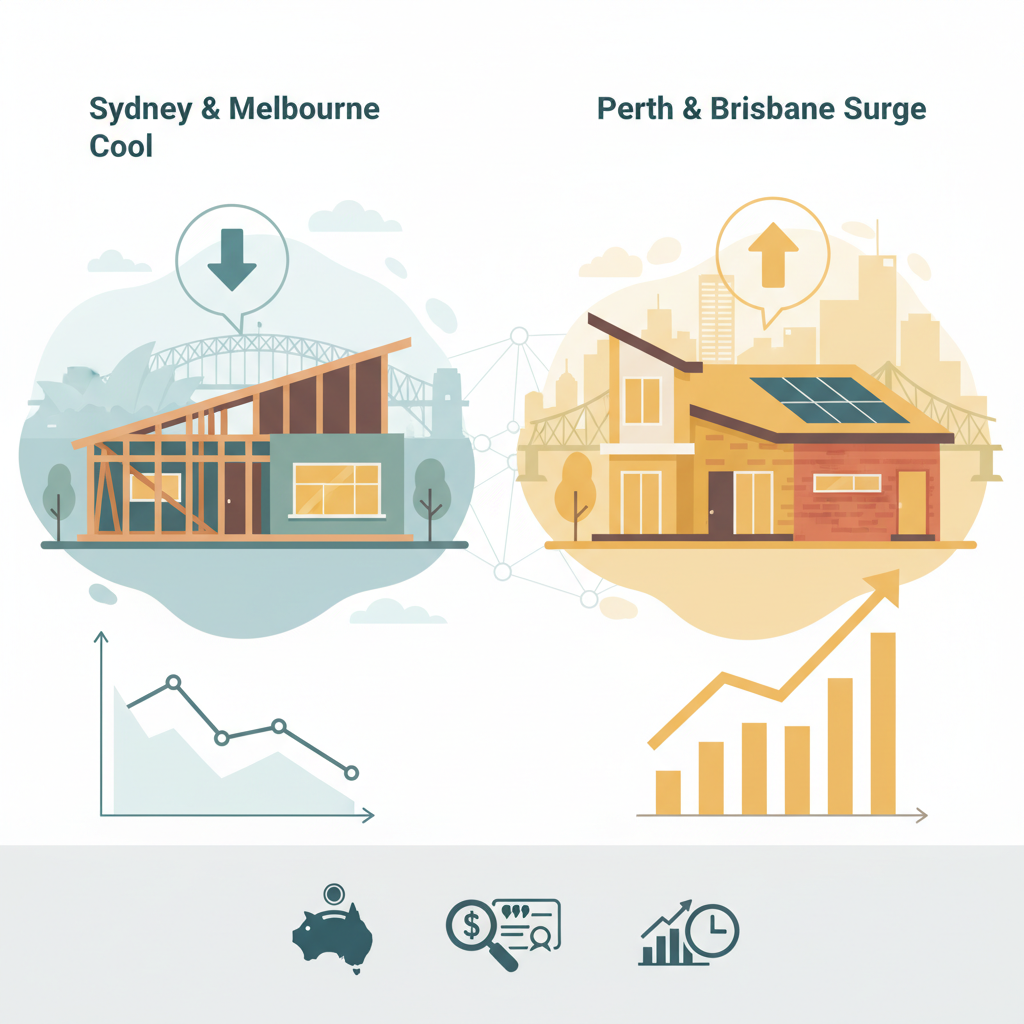
TL;DR: Australia’s housing market is currently operating at two distinct speeds in early 2026. Sydney and Melbourne are experiencing a cooling phase with house price falls of 2.5% to 4.0% in Q1, driven by high interest rates and affordability issues. Meanwhile, Perth and Brisbane are surging, recording robust gains of 3.5% to 6.0% in the same period, fuelled by strong population growth and limited housing supply.
Key Takeaways
- Divergent Markets: Early 2026 shows a clear ‘two-speed’ housing market across Australia.
- Sydney & Melbourne Cooling: Both cities saw price declines of 2.5% to 4.0% in Q1 2026, mainly due to sustained high interest rates and affordability issues.
- Perth & Brisbane Surging: These Western and Eastern capitals recorded strong price gains of 3.5% to 6.0% in Q1 2026, driven by high migration and tight housing supply.
- Economic Drivers: Differing economic conditions, population inflows (especially interstate migration), and housing supply levels are the main reasons for this split.
- Budgeting Impact: This market shift directly affects renovation and construction costs, with builder availability and labour rates varying significantly by region.
- Informed Decisions: Homeowners and prospective buyers need suburb-level data and solid budgeting tools to navigate these dynamic market conditions effectively.
What is Driving Australia’s Two-Speed Housing Market in 2026?
Australia’s residential property market is showing a clear ‘two-speed’ trend in early 2026, with major capital cities moving in different directions. This split comes down to varying economic conditions, different rates of population growth, and contrasting housing supply levels across the states. While higher interest rates from the Reserve Bank of Australia (RBA) affect all regions, local dynamics either amplify or lessen their impact.
You need to understand these localised shifts if you’re planning to build or renovate, as costs, builder availability, and property values are directly influenced. HomeBuildBudget helps you assess these specific conditions with our Cost Calculator, providing suburb-level cost data across Australia. For instance, the RBA’s cash rate, currently at 4.35% as of April 2026, continues to put pressure on your borrowing capacity, impacting affordability nationwide.
Why Are Sydney House Prices 2026 and Melbourne Property Market Outlook Cooling?
Sydney house prices in 2026 and the Melbourne property market are cooling mainly due to the ongoing impact of higher interest rates. These rates have significantly tightened borrowing capacity and reduced how much buyers can afford. CoreLogic’s Q1 2026 Market Update reported that Sydney house prices fell by an average of -3.2%, while Melbourne’s saw a -2.8% decline over the same period. This trend is made worse by high household debt levels and an increase in new housing supply completions in both cities.
Additionally, fewer overseas migrants entering these larger capitals, compared to smaller states, has helped rebalance demand and supply somewhat. If you’re buying in these markets, you can use this increased negotiation power. Homeowners considering renovations might also find more competitive builder quotes. Use HomeBuildBudget’s Builder Quote Comparison to analyse up to 5 builder quotes side-by-side, ensuring you get the best value in a cooling market.
For renovators, even though property prices are softening, building costs remain high. According to the Housing Industry Association (HIA) March 2026 report, construction costs across NSW and Victoria are still growing annually. Average new home build costs in Sydney for standard finishes range from $2,500 to $4,000 per square metre. This means your renovation budget needs careful planning, even if your property value isn’t appreciating as fast.
What Are the Key Perth Housing Market Trends and Brisbane Property Price Forecasts?
Perth housing market trends and Brisbane property price forecasts are very strong in early 2026. This is thanks to solid population growth, healthy employment figures, and an ongoing lack of available housing. Perth recorded an impressive +5.5% increase in house prices in Q1 2026, while Brisbane saw a solid +4.8% gain, according to CoreLogic data. These cities are standout performers in the national market.
Both Western Australia and Queensland have seen significant interstate migration. ABS October 2025 data shows positive net migration flows adding substantially to their populations. This growth, combined with slower new housing construction relative to demand, has created incredibly tight rental markets and strong upward pressure on property values. If you’re a homeowner in these cities, understanding demand for specific renovation types is key; HomeBuildBudget’s Renovation ROI Calculator can estimate the return on investment by suburb and property type.
For example, the median house price in Perth has risen to approximately $720,000 as of Q1 2026, and in Brisbane, it sits around $880,000. This makes building new homes or undertaking significant renovations an attractive option, provided you can secure competitive building costs. Our Suburb Cost Data offers granular cost-per-square-metre information for over 2,500 Australian suburbs, updated quarterly, to help you plan accurately.
How Does This Two-Speed Market Affect Your Building or Renovation Budget?
The two-speed housing market hits your building or renovation budget hard, mainly through different land values, builder availability, and labour rates. In hot markets like Perth and Brisbane, high demand for construction means you could see:
- Higher Builder Premiums: Builders might charge more due to heavy workloads, sometimes adding 10-15% to project costs compared to quieter markets, according to the Master Builders Australia (MBA) Q1 2026 report.
- Longer Wait Times: Securing a builder can take months, delaying projects and potentially increasing overall costs due to inflation or material price shifts.
- Increased Labour Costs: Fewer skilled trades pushes up hourly rates for electricians, plumbers, and carpenters.
In cooling markets like Sydney and Melbourne, you’ll likely find builders more competitive and available. This could save you 5-10% on quotes or give you more flexibility. However, building material costs, as noted in our related post about Australian home building costs surge, remain elevated nationally.
To effectively manage your budget, you need to track every expense. HomeBuildBudget’s Budget Tracker allows you to track actual spending against your estimates in real-time. You’ll receive instant alerts if you exceed a category threshold, helping you stay on top of your finances no matter the market speed. Remember, even in a cooling market, securing a fixed-price contract can be challenging due to ongoing material cost volatility, a risk discussed in our article on fixed-price contracts at risk.
| Market Indicator (Q1 2026) | Sydney | Melbourne | Perth | Brisbane |
|---|---|---|---|---|
| Median House Price | ~$1,350,000 | ~$950,000 | ~$720,000 | ~$880,000 |
| Q1 2026 House Price Change | -3.2% | -2.8% | +5.5% | +4.8% |
| Annual Population Growth (est.) | 1.5% | 1.8% | 2.9% | 2.5% |
| Median Days on Market | 45 days | 40 days | 18 days | 22 days |
| New Dwelling Approvals (vs. Q1 2025) | -8% | -10% | +15% | +12% |
Source: CoreLogic Q1 2026 Market Update, ABS October 2025 Migration Data (estimated for Q1 2026)
How Can HomeBuildBudget Help You Navigate These Shifting Markets?
Australia’s 2026 housing market is tricky. You’ll need precision, local data, and good budgeting tools to get through it. HomeBuildBudget gives Australian homeowners and buyers exactly that, helping you make smart decisions whether you’re building a new home or doing a major renovation. Our platform has features to help you adapt to regional market differences.
Our Cost Calculator provides accurate construction cost estimates by room type, material grade, and crucially, suburb-level labour rates across Australia. This means you get a highly tailored estimate, reflecting the true costs in your specific area, whether it’s a surging market like Perth or a cooling one like Sydney. You can budget with confidence, knowing your estimates are based on current, local data.
Our Suburb Cost Data also gives you detailed cost-per-square-metre information for over 2,500 Australian suburbs, updated quarterly from ABS and industry sources. This helps you quickly see how land values and construction costs stack up across regions. You can then spot areas where your budget goes further or where you’ll need to pay more. For example, you can compare the average cost of a standard kitchen renovation in Perth (~$30,000–$50,000) versus Sydney (~$40,000–$70,000) and understand the underlying cost drivers.
Lastly, our Budget Tracker lets you watch your actual spending against your initial estimates, live. You’ll get instant alerts if you spend too much in any category. This is super helpful in dynamic markets where costs can jump without warning. This stops budget blowouts and keeps your project on track. You’ll have peace of mind throughout your build or renovation.
Frequently Asked Questions
What is a ‘two-speed’ housing market in Australia?
A ‘two-speed’ housing market refers to a scenario where different regions or cities within Australia show vastly different property market performances simultaneously. In early 2026, this means some capital cities are seeing declining prices while others are experiencing strong growth, largely due to unique local economic and demographic factors. This divergence makes localised data essential for decision-making.
Why are Sydney and Melbourne house prices cooling in 2026?
Sydney and Melbourne property markets are cooling primarily due to high interest rates impacting affordability, alongside increased housing supply completions and fewer overseas migrants compared to smaller capitals. High household debt levels in these major cities also contribute to subdued buyer demand, as reported by CoreLogic’s Q1 2026 Market Update. Homeowners in these areas should focus on value-adding renovations that align with current market preferences.
What is driving the housing market surge in Perth and Brisbane?
Perth and Brisbane’s housing markets are surging in early 2026 mainly due to strong interstate and overseas migration, solid employment growth, and an ongoing lack of housing. These factors create intense buyer demand that outweighs available listings, pushing prices upwards, according to ABS October 2025 migration data and CoreLogic’s Q1 2026 report. This creates opportunities for sellers and those looking to build new homes.
How does the two-speed market impact my renovation budget?
The two-speed market directly impacts renovation budgets through varying labour and material costs. In surging markets like Perth and Brisbane, high demand can lead to increased builder premiums and longer wait times, whereas cooling markets like Sydney and Melbourne might offer more competitive quotes. HomeBuildBudget’s Cost Calculator can provide suburb-level cost data to help you accurately plan and anticipate these regional differences.
Should I buy or sell in a two-speed housing market?
The decision to buy or sell in a two-speed housing market depends heavily on your specific location and financial situation. Buyers in cooling markets like Sydney might find more negotiation power and opportunities, while sellers in surging markets like Perth could achieve higher prices due to competitive demand. Always consider local market conditions, your long-term goals, and get accurate cost estimations for any potential build or renovation using HomeBuildBudget.
Plan Your Next Project with Confidence
Australia’s 2026 housing market presents both challenges and opportunities, depending on your location. Whether you’re navigating cooling conditions in Sydney or Melbourne, or capitalising on the growth in Perth and Brisbane, having accurate, up-to-date data is paramount.
Don’t let market shifts derail your building or renovation dreams. Use HomeBuildBudget’s comprehensive tools to get suburb-level cost data, compare builder quotes, and track your budget in real-time.
Related Articles
Australian Construction Outlook 2026: Record Pipeline Meets Rising Costs
Australia's $450B construction boom meets persistent labour shortages and rising costs from global energy shocks. What homeowners need to know in 2026.

Fixed-Price Building Contracts at Risk: Navigating Rising Costs
Fixed-price building contracts face severe risk from surging PVC, cement, and quarry costs in Australia. What homeowners must know to protect themselves.